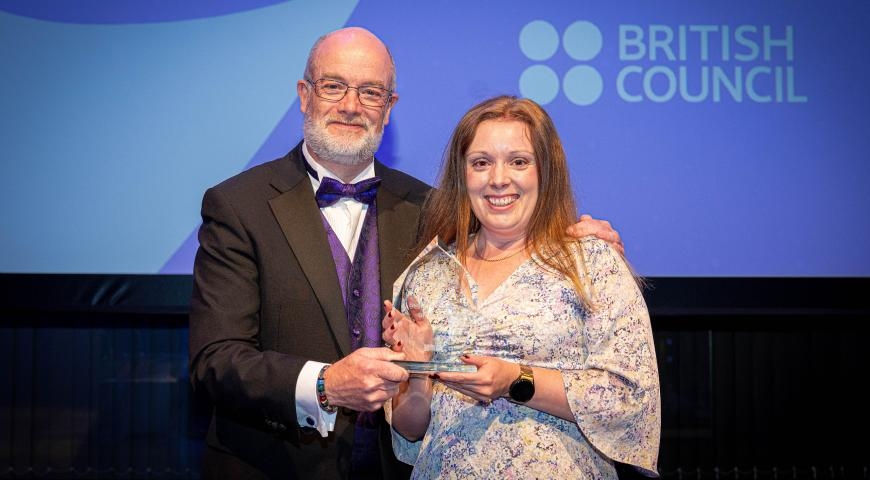
Winner: Cambridge University Press & Assessment with Digital Assessment of Computer Science
Our team is transforming Computer Science assessment by creating a digital exam that authentically reflects real-world programming practice. Recognising the limitations of raditional paper-based exams, we identified a need for students to demonstrate coding skills in a practical, interactive environment.
Our team engaged with hundreds of teachers across the UK and internationally, gathering insights through focus groups, interviews, surveys, and school visits. Prototypes and demos were shared throughout development, ensuring the product evolved based on continuous feedback. Testing covered platform features such as progress bars, countdown clocks, and accessibility tools, as well as assessment content and functionality.
We designed and implemented an Integrated Development Environment (IDE) within the exam, enabling candidates to write, test, and run code during assessment. We introduced innovative item types, including a flowchart editor, logic gate editor, and interactive coding tasks, to provide a richer and more authentic experience. This also reflects good classroom practice and is an area that has been thoroughly researched.
Through ongoing engagement and rapid iterations, our team keeps teachers and students at the heart of development. This work sets a new standard for digital assessment, ensuring learners are better prepared for higher education and the workplace.
Finalists:
Robert Chmielewski exemplifies sector leading digital assessment practice in terms of effectively utilising a tool in an unscripted, bespoke way for an integral university marking process. The solution in question was developed in response to the University of Edinburgh’s demanding double blind marking requirements, turning it into a coherent, dependable, and scalable digital workflow that now supports multiple schools. His contribution ensures fairness, efficiency, mpartiality, and transparency in one of the university’s most high stakes assessment processes. What sets Robert apart is his ability to take a complex regulatory requirement and translate it into a workflow that can be relied on with little difficulty by large cohorts of students, markers, and administrators. His approach is about tackling complexity whilst serving it as something relatively simple. He demonstrates the combination of technical understanding, practical marking workflow insight, and academic empathy required to make double blind marking genuinely achievable at scale.
The OpenEyes Technologies Voiceover Intelligence team is visionary in redefining how assessments can function in a digital world. Rather than improving existing exam formats incrementally, the team recognized the structural limitations of typing-based, visually dependent assessment systems and pioneered a voice-first approach that enables candidates to demonstrate knowledge through natural speech while ensuring continuous identity verification. The team is deeply committed to inclusivity. They identified that traditional digital assessments unintentionally exclude or disadvantage many capable learners, including those with visual impairments, motor limitations, dyslexia, or other accessibility challenges. By enabling voice as a primary assessment interface, the team has expanded participation without requiring separate accommodations or alternative workflows. Their work is transformational because it introduces a new paradigm for secure and accessible digital assessment. By combining speech recognition, voice biometrics, and AI-driven analysis, the team has demonstrated that assessment can be both more secure and more accessible simultaneously. They deserve recognition for advancing digital assessment in a way that benefits learners, assessment providers, and the broader education and certification ecosystem. Their work helps ensure that assessment measures knowledge more accurately while removing unnecessary barriers that prevent learners from demonstrating their true ability.
Trushant deserve recognition for transforming digital assessment into a trust by design experience that protects learners from manipulative UX (“dark patterns”) while improving outcomes. His sessions and implementations focus on transparent consent, explainable AI, and flexible pacing, ensuring assessments cultivate curiosity rather than compliance. As regulators intensify enforcement against dark patterns, his work helps institutions move from compliance risk to learner centered excellence, aligning pedagogy, ethics, and performance.
Our team is transforming Computer Science assessment by creating a digital exam that authentically reflects real-world programming practice. Recognising the limitations of raditional paper-based exams, we identified a need for students to demonstrate coding skills in a practical, interactive environment. Our team engaged with hundreds of teachers across the UK and internationally, gathering insights through focus groups, interviews, surveys, and school visits. Prototypes and demos were shared throughout development, ensuring the product evolved based on continuous feedback. Testing covered platform features such as progress bars, countdown clocks, and accessibility tools, as well as assessment content and functionality. We designed and implemented an Integrated Development Environment (IDE) within the exam, enabling candidates to write, test, and run code during assessment. We introduced innovative item types, including a flowchart editor, logic gate editor, and interactive coding tasks, to provide a richer and more authentic experience. This also reflects good classroom practice and is an area that has been thoroughly researched. Through ongoing engagement and rapid iterations, our team keeps teachers and students at the heart of development. This work sets a new standard for digital assessment, ensuring learners are better prepared for higher education and the workplace.


