Ofqual confirms on-screen assessment for new vocational qualifications
RM Assessment
The Most Innovative Use of Technology in Assessment award recognizes a project that has been highly innovative in terms of new technology, or how existing technology has been used in a new and different way.
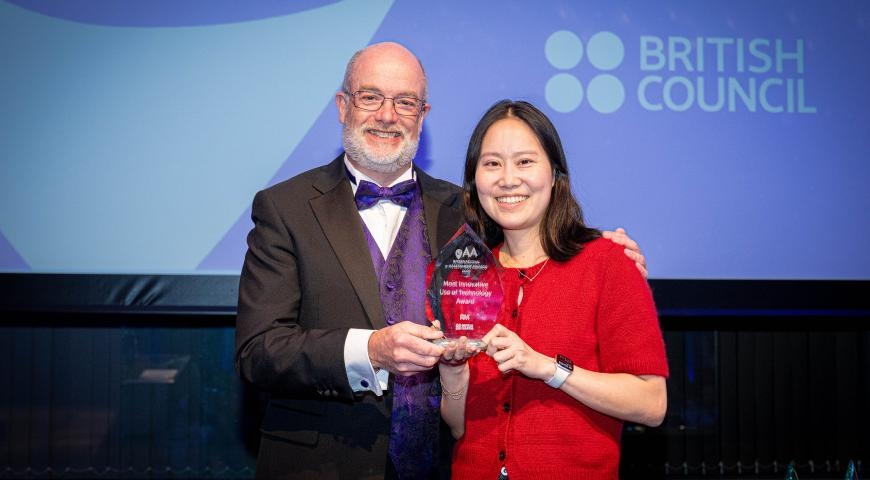
Winner: Duolingo with The Duolingo English Test Interactive Speaking Task
Imagine taking a language test where, instead of just talking at your computer, you actually have a back-and-forth conversation with an AI. It listens to what you say, asks follow-up questions that match your level, and evaluates your responses on the spot. That’s what we built. It feels like talking to a person, but it’s fully automated and scalable to millions. Behind the scenes, advanced speech recognition and AI models power this interaction, and a statistical engine adjusts your score to account for question difficulty so that your score is both fair and personalized. It’s like having a live speaking interview, available anytime, anywhere, for anyone.
Finalists:
Cambridge English Qualifications Digital for Young Learners (DYL) is a new summative test of English for primary-age non-native English speakers. The first two levels (Starters Digital and Movers Digital) launched globally in January 2025; the third level (Flyers Digital) launches in 2027. While Cambridge has provided paper-based young learner English tests since 1997, DYL offers a digital alternative designed to put young people at ease in an online environment that feels more natural than paper and pen. Cambridge English Qualifications Digital for Young Learners combines a clear need to support students’ wellbeing and motivation with the innovation of a game-inspired approach to an English assessment. The test has been developed and launched in alignment with schools’ and exam centres’ needs and goals and is now having a positive impact in terms of delighted reactions from students and educators and operational benefits to exam centres.
Exams with written answers take a very long time to check because a human has to read every page, one by one. This causes delays, high costs, and sometimes inconsistent marking. ClassMap is a system that can read handwritten answers, understand what the student is trying to say, and compare it with the correct answer pattern—just like a teacher would, but much faster. It helps teachers finish the checking process quicker, publish results sooner, and spend more time teaching instead of doing repetitive evaluation work.
Handwriting should never influence how a candidate is judged. Yet when examiners read handwritten scripts directly, legibility, neatness, and presentation can unconsciously shape interpretation—creating avoidable disadvantage for some students. Developed in partnership between Excelsoft Technologies and AQA, one of the UK’s largest awarding bodies, this project goes far beyond converting handwriting into typed text. It delivers a multi-layer analytical transcription system designed for high-stakes assessment: transcribing handwritten responses, detecting and preserving strikethroughs/amendments, reconstructing the candidate’s final intended answer, assigning word-level confidence scores, flagging issues at individual-word granularity, and producing comprehensive quality analytics. A controlled pilot processed 1,075 script images across seven GCSE Science question types, achieving 86%–97% accuracy. Crucially, it handled one of the hardest realities of real scripts: students crossing out, rewriting, and crossing out again—requiring the system to follow the “path of thinking” and determine the final response as per a defined protocol. This solution does not mark scripts. It creates a structured, standardised, auditable digital representation of handwritten responses that could support multiple downstream use cases. Our next focus for a future pilot is quality assurance & operational validation. The innovation is analytical evidence that makes transcription governable, reviewable, and suitable for high-stakes environments.
Imagine taking a language test where, instead of just talking at your computer, you actually have a back-and-forth conversation with an AI. It listens to what you say, asks follow-up questions that match your level, and evaluates your responses on the spot. That’s what we built. It feels like talking to a person, but it’s fully automated and scalable to millions. Behind the scenes, advanced speech recognition and AI models power this interaction, and a statistical engine adjusts your score to account for question difficulty so that your score is both fair and personalized. It’s like having a live speaking interview, available anytime, anywhere, for anyone.
Join the global community advancing e-assessment through innovation, research, and collaboration.


Keep informed