Surpass
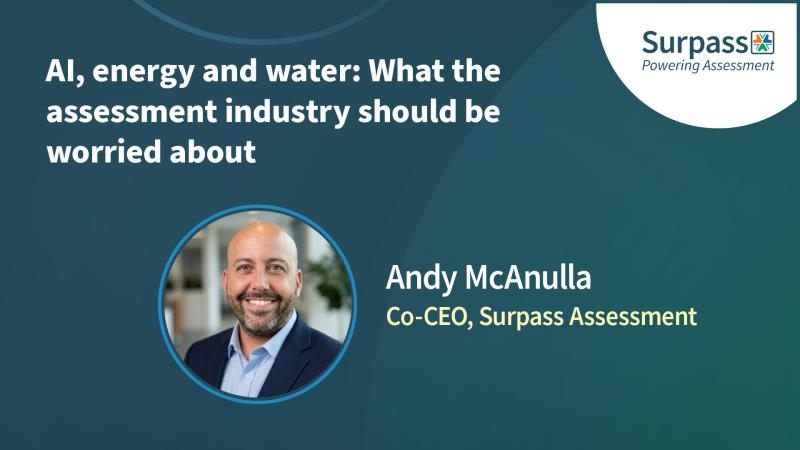
AI, energy and water: What the assessment industry should be worried about
Andy McAnulla
Co-CEO
1st July 2026
Separating the headlines from data: what responsible AI use looks like for high-stakes assessment
The environmental cost of AI has become a key concern raised by clients, regulators and the assessment community. It is also one of the most poorly understood topics. Numbers are often quoted from headlines that misread the underlying research, and AI is often compared with nothing, rather than comparing it to digital activities people already do without a second thought.
The goal of this article is to lay out what the current research actually shows, where the legitimate concerns lie, and why we believe responsible AI adoption is more environmentally credible than the alternative of inaction. It also explains how Surpass is approaching this as a supplier, including the offsetting and governance commitments we already have in place.
The per-prompt numbers are smaller than the headlines suggest
Two recent disclosures from AI providers themselves, with published methodology, have shifted what we can credibly say.
Google’s August 2025 technical paper, with published methodology, puts a median Gemini text prompt at 0.24 Wh of energy and 0.26 mL of water, covering the full stack including idle capacity and data centre overhead. OpenAI disclosed in June 2025 that the average ChatGPT query uses 0.34 Wh and roughly one-fifteenth of a teaspoon of water.
Read the full article here