Privacy concerns with online proctoring and how to address them
PSI
By eAA Board member, Tim Burnett.
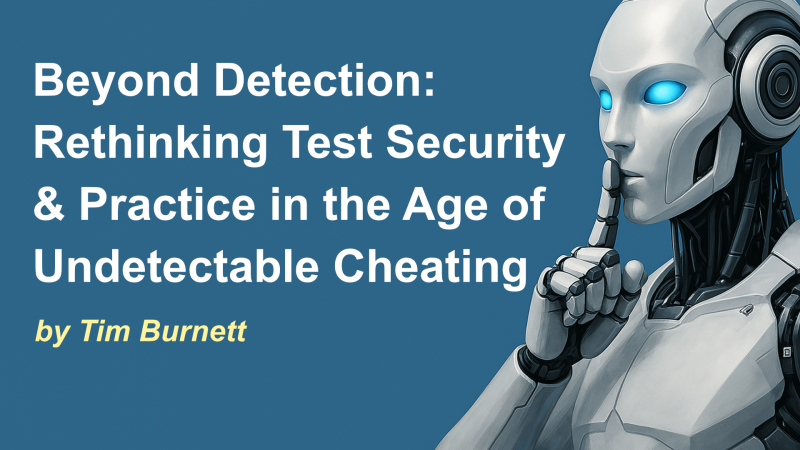
Following the eye-opening webinar “Creating AI-based Cheating Tools for Assessments,” it’s clear that educational institutions and awarding organisations face unprecedented challenges to assessment integrity in an era where AI tools are becoming increasingly sophisticated and undetectable.
As one participant in a recent webinar on the subject noted, “Thus far, we are losing the battle against online remote proxy.” This stark assessment encapsulates the urgency of the situation facing educators worldwide.
The solution, however, isn’t simply to fight a perpetual rear-guard action against technological advancement. Instead, a comprehensive and collaborative approach is needed, one that encompasses three critical strategies: Revise, Relocate, and Rethink.
The Current Challenge: Always Playing Catch-Up
“The problem we always have is that people who want to cheat will find new ways to do it which we haven’t even thought of as a possibility. We will always be playing catch up,” observed one participant during the webinar.
This sentiment captures the fundamental challenge facing assessment organisations and educational institutions today. AI tools capable of generating human-like responses are advancing at a pace that detection methods simply cannot match. When these tools are combined with remote proctoring vulnerabilities, the integrity of traditional assessment methods comes under serious threat.
The inadequacy of piecemeal approaches has become increasingly apparent. Individual institutions implementing isolated solutions find themselves outpaced by rapidly evolving technology. As one assessment leader emphatically stated, “AO’s need to work together to solve this problem. I don’t see any one organisation doing this on their own.”
This call for collaboration and support from regulators represents not just a preference but a necessity in addressing the systemic challenge of AI-enabled assessment malpractice.
Revise: Immediate Action on Existing Assessment Controls
The first step an Awarding Organisation should take with existing assessments is to evaluate the risk for their assessment based on the assumption that candidates have access to real-time video AI tools during an online assessment event.
Working back from this, AOs need to evaluate their existing policies, procedures and processes to see what measures can be taken to safeguard exam delivery.
Depending on the culture, stakes, and access to levels of knowledge and understanding candidates within your subject domains, this may not be an immediate threat.
Domains such as IT Certification at present are probably one of the most at risk due to the IT competency of the candidates and the benefits that can be gained from shortcutting the assessment process.
But, by working on the assumption that all test candidates will at some point in the near future have easy undetectable access to highly capable AI-based technology, you are taking a firm and positive step in protecting your integrity, your brand and the lives of people that depend on high standards in assessment.
Any measures you take at this point must be done in line with your commitments to access to assessment and fair testing processes. This revision process must maintain accessibility standards while enhancing security.
Any new assessment designs must consider the diverse needs of all learners, ensuring that anti-cheating measures don’t inadvertently create barriers for candidates.
Relocate: Strategic Environment Control
While many consider a wholesale return to testing centres isn’t the answer—as one participant noted on the webinar, “going back to test centres is not the answer. We’ll just see increases in proxy test takers”—there may be a case for strategic relocation of certain high-stakes assessments to more controllable environments. The key is selectivity based on risk assessment.
Assessments particularly vulnerable to AI manipulation or with significant consequences (professional certifications, major examinations, or gateway assessments) may warrant the additional security of some form of test centre.
Test centres have their own integrity risks, but in many cases, they will offer a more secure modality of testing than some forms of online proctored assessments.
The decision to relocate an assessment should emerge from collaborative risk analysis, weighing factors such as the stakes involved, the vulnerability of the assessment format, and the available security infrastructure.
In some cases, it is worth considering the use of paper in testing scenarios. Paper-based assessment has seen a decline following many digital transformation processes; however, paper offers stronger guarantees that a human created the responses by significantly reducing opportunities for AI interference. Whilst some research has indicated that the majority of candidates prefer digital assessment, the minority should never be ignored when we consider fairness in assessment.
Rethink: Reconceptualising Assessment in the AI Era
Perhaps the most profound change needed is a fundamental rethinking of what assessment means in an AI-enhanced world.
Based on what attendees witnessed during the webinar demonstrations, and given what is already available now, efforts to address these challenges should be tripled immediately. The pace of development in AI capabilities means that delaying action is not an option.
AI tools are becoming an integral part of the professional landscape that today’s students will enter. Webinar delegates frequently raised the point that we should be looking for alternative ways to assess candidates.
This does need to be the focus of our discussions at events such as the e-Assessment Association’s 2025 Conference in London.
I myself am particularly keen to tackle this challenge and will be running a hands-on workshop at the conference in the interactive computer lab called “No Code Needed” which will give delegates an opportunity to use AI development tools to collaborate and create new assessment designs for the future.
In addition to this workshop, the conference is an excellent opportunity for members of the assessment community to network and discuss the challenges they face with the potential for finding friends and supporting collaborating members in the community.
Moving Forward Together
The webinar attracted significant interest, with 164 registrations from global assessment professionals. This widespread participation demonstrates the universal concern about AI challenges across the assessment sector. The event brought together representatives from leading awarding organisations, educational institutions, and testing bodies worldwide.
Global Leaders in Attendance
The webinar’s impressive attendance included professionals from ten major global organisations:
The risks faced by these and other assessment organisations will vary. Tim first presented his views on this matter at the eAA’s February Assessment Organisation Network meeting hosted by the Royal College of Emergency Medicine in London.
Like many on the recent Test Community Network webinar, many found it very uncomfortable to realise the full potential of AI on this matter, whilst many who were already investigating such matters were clear that this was an active risk for them.
By adopting the Three Rs approach—Revise, Relocate, and Rethink—and emphasising collaboration at every stage, awarding organisations and educational institutions can transform a potential crisis into an opportunity for meaningful improvement.
We’ve all wanted to change assessment for the better for many years; therefore, let’s embrace this opportunity as a community.
The future of assessment integrity doesn’t lie in a single perfect solution, but rather in the combined effort of awarding organisations, educational institutions, educators, technologists, and assessment specialists working together to continuously revise, strategically relocate, and fundamentally rethink how we evaluate learning in the AI era.
Only through such comprehensive collaboration can we hope to maintain the integrity and meaning of educational assessment in a rapidly changing technological landscape.
Members of the assessment community can access the “Creating AI-based Cheating Tools for Assessment” webinar by visiting the Test Community Network website and requesting access: https://www.testcommunity.network/test-community-network-live
Due to the sensitive nature of the topic, all requests will be monitored before access is granted.
About the Author:
Tim Burnett is a Board Member of the e-Assessment Association and an active member of the global assessment community. As Founder of the Test Community Network, he brings over 20 years of experience driving innovation in educational technology and high-stakes assessment. Tim is a trusted advisor to awarding organisations and technology providers, offering independent, practical guidance on how to embrace AI without compromising assessment integrity. Through consulting, podcasts, and industry events, he helps organisations turn AI from a risk into a strategic advantage. Connect with Tim to explore how AI can future-proof your assessment offerings and position your organisation for long-term success.
Connect: https://www.linkedin.com/in/tburnett/
Chat: https://calendly.com/educationtech/15min-teams-chat
Join the global community advancing e-assessment through innovation, research, and collaboration.


Keep informed