
Privacy concerns with online proctoring and how to address them
PSI
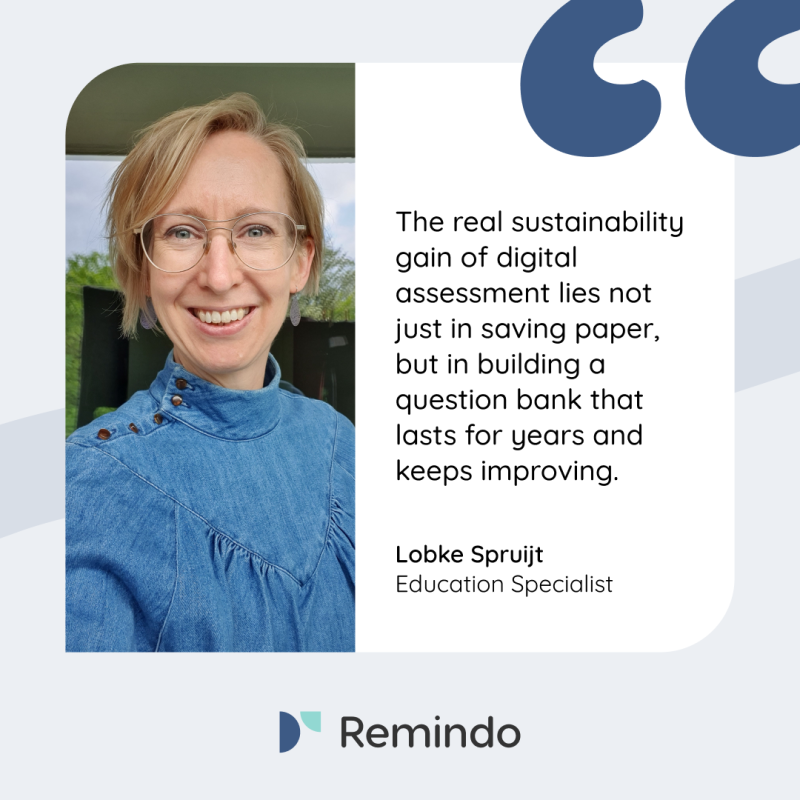
By Education Specialist Lobke Spruijt
The most straightforward answer is that digital exams do not use paper, which saves vast amounts of paper.
In this blog, I want to outline several additional reasons why digital testing is more sustainable than traditional paper-based exams—beyond just conserving raw materials. First, when exams are conducted digitally, the use of paper is significantly reduced. Candidates simply log into Remindo to take their tests without the need for physical question and answer sheets, eliminating the risk of forgetting any candidates. This not only conserves paper but also reduces transportation needs if candidates and proctors do not have to travel to a specific testing location. Overall, these advantages outweigh the energy consumed in administering digital exams
There are other factors that contribute to the sustainability of digital testing. One key aspect is the use of a well-structured test blueprint and effective question management. When you design your blueprint around test objectives—such as learning goals—and create a strong, varied set of questions, Remindo can randomly generate unique yet equivalent tests for each candidate. If a candidate needs to retake an exam, the same blueprint can be utilized; Remindo will provide a new set of questions that the candidate has not encountered previously.
If you wish to fix a specific set of questions for a particular instance, Remindo can generate those from the established blueprint. This is what I refer to as a sustainable blueprint: one that can be reused for years, as long as the objectives remain unchanged. Creating such variants on paper is much more labor-intensive, as each version must be produced individually and carefully tracked to prevent any exam paper from leaving the testing location.
Moreover, reusing quality questions is essential. With paper-based exams, once the answers are collected and graded, the data must be manually entered before analysis can begin. In contrast, Remindo processes this data instantly. This saves time, allowing you to focus on what truly matters: the quality of the questions, and consequently, the quality of the exam. You can decide to remove, improve, or add questions to your item bank based on analysis results. This approach helps build a sustainable collection of
accurate, up-to-date, and relevant questions, ensuring that your blueprints can continuously draw from a rich pool of quality items.
In summary, this methodology is sustainable not only in terms of resources but also in terms of time and energy—energy that can now be devoted to enhancing exam quality rather than being consumed by administrative tasks.
Join the global community advancing e-assessment through innovation, research, and collaboration.


Keep informed